Nokom Bedrock Crater
Far from the Madding CrowdThe Norcombe chalk-pit is a generations-old quarry beyond Norcombe Hill, its chalk spread on neighboring farms and its edge incorporated into a line of converging hedges. Its most consequential appearance is as the fatal endpoint of a sheepdog’s misguided attempt to manage Gabriel Oak’s flock: two hundred ewes fall into the pit, destroying Oak’s prospects as an independent farmer. The place joins ordinary rural infrastructure to sudden catastrophe, and makes the landscape itself an agent in the novel’s reversal of fortune.
Setting and Physical Features
The pit lies on the far side of Norcombe Hill, where two hedges converge in a V without quite meeting. Their narrow opening is immediately above the brow of the quarry and is protected by a rough railing. Chalk had been extracted there for generations and spread over adjacent farms, so the pit belongs to the working landscape rather than appearing as an isolated wilderness. Yet the familiar agricultural setting conceals a steep, lethal drop: hedges, fields, and a barrier that is already described as rotten meet at the edge of the excavation.
The account establishes the pit’s danger through its approach. The sheep break through a gap in a hedge, cross the upper field, and reach the point where the converging hedges end at the brow. At the summit, the young dog stands motionless against the sky; beyond the broken rails, Oak finds the footprints of his ewes. The route from pasture to precipice is therefore legible in the damage left behind, while the quarry’s depth becomes clear only when Oak looks over the edge.
The Flock’s Fall
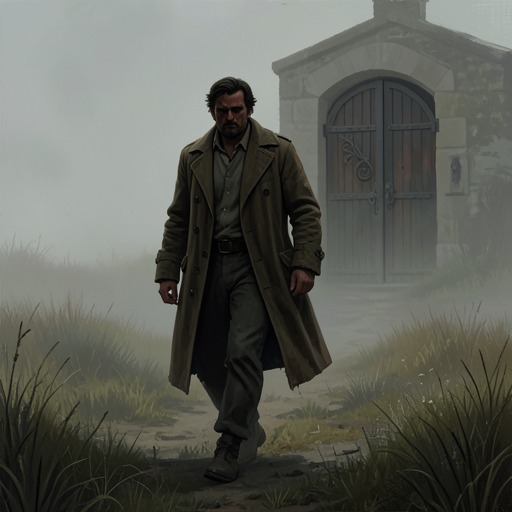
The disaster begins with the absence of the young dog. Oak had left him and the older dog, George, on the hill while they ate a dead lamb. Before dawn, the familiar sound of the sheep’s bells wakes Oak, but the quick, regular ringing tells him that the flock is running at great speed. He hurries up the hill through the fog and discovers that the main body of his flock has vanished; only the fifty ewes with lambs, enclosed separately, remain where he left them.
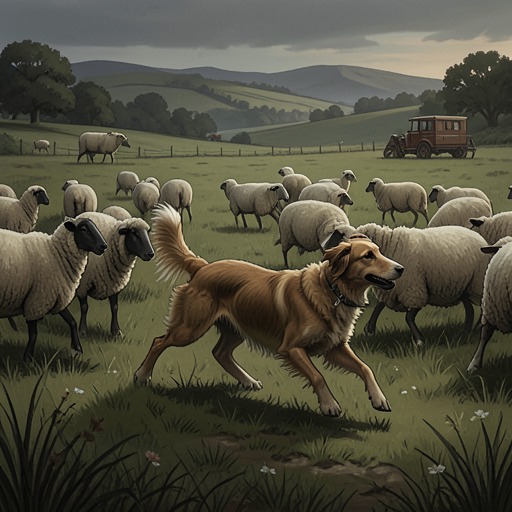
Following the footprints, Oak initially supposes that the sheep have broken through the hedge because they are seeking winter ivy in the plantation. They are not there. At the hill’s summit he finds the young dog, who approaches and licks his hand as though expecting a reward for good work. Oak then sees the broken railing and the flock below: two hundred ewes lie dead or dying at the bottom of the pit, their mangled bodies amounting, in the immediate estimate, to the loss of two hundred more. The dog had gathered them in a corner and driven them forward by worrying them until they broke through the barrier and went over the edge.
The young dog’s conduct follows the purpose for which he was being trained, but without the restraint that experience would have supplied. He is earnest and energetic, yet cannot distinguish work done well enough from work done too thoroughly; the older George had served as the practical check on his excess. After the fall, the young dog is shot that day. The quarry thus marks the consequence of an animal’s disastrously over-literal training, as well as the failure of a fence too weak to stop the flock.
Loss and Narrative Significance
At the pit, Oak first responds to the sheep as living creatures: his immediate feeling is pity for the ewes and their unborn lambs. The scale of the loss then becomes economic. The flock is uninsured, and its destruction wipes out the savings of his frugal life and the hopes he had built of becoming an independent farmer. His first spoken reflection is gratitude that he is not married, since he would otherwise have had another person to support in the poverty that follows. The quarry is therefore the site of both a mass animal death and a reversal in Oak’s social and financial position.
The narrative lingers over what Oak sees beside the pit after the disaster: an oval pond, the thin yellow moon reflected in it, and the morning star’s image stretched across the water by the breeze. The quiet, altered surface contrasts with the heap of sheep below. Oak notices and remembers the scene, but the landscape offers no remedy for the loss. The contrast makes the pit more than a backdrop: it becomes the physical point at which the precariousness of a farmer’s independence is exposed, and from which Oak must begin again with little more than the clothes he stands in.